


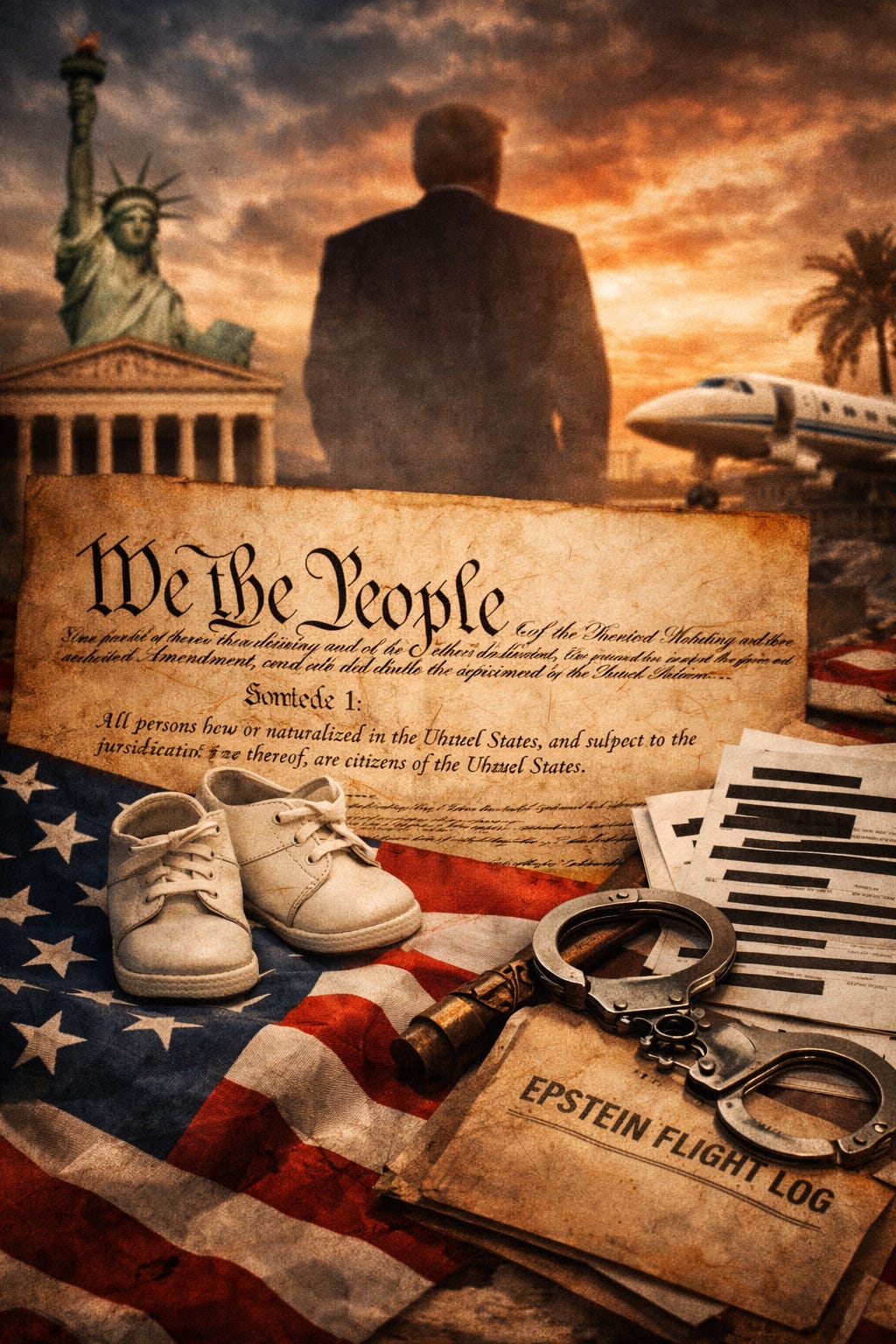
Barron Trump is an American citizen. He is an American citizen because the constitutional principle now under attack protected his birth.
He is an American citizen because he was born in New York City in 2006. That fact alone places him within the protection of the Fourteenth Amendment to the United States Constitution, which declares:
“All persons born or naturalized in the United States, and subject to the jurisdiction thereof, are citizens of the United States…”
For more than a century, this clause has been understood with remarkable clarity. The Supreme Court confirmed its scope in United States v. Wong Kim Ark, holding that birth on American soil establishes citizenship, regardless of the nationality of one’s parents, with narrow exceptions not relevant here.
Barron Trump’s citizenship is not controversial. It is not ambiguous. It is not theoretical.
It is settled law.
Yet now the machinery of power argues that this clause — written in the aftermath of slavery — should be read more narrowly than generations of Americans have understood it.
We are told the amendment was only meant to address one historical injustice, not to establish a durable principle.
But the authors of the amendment themselves anticipated this argument.
And they rejected it.
The historical record speaks plainly
In 1866 — after a constitutional order that tolerated slavery collapsed under the weight of its own contradictions — Congress debated the Civil Rights Act that would become the foundation of the Fourteenth Amendment. Senator Jacob Howard explained the citizenship clause in language that leaves little room for ambiguity:
“This amendment… declares that every person born within the limits of the United States… shall be regarded as a citizen of the United States.”
Howard then clarified the intended breadth of the principle:
“This will include every other class of persons.”
Not some.
Not a few.
Every other class.
Senator John Conness of California made the point even more explicitly, addressing concerns about children born to immigrants:
“The proposition before us… relates simply… to the children begotten of Chinese parents in California, and it is proposed to declare that they shall be citizens.”
The answer was yes.
Yes, even then.
Yes, even there.
The authors of the amendment understood perfectly well that the rule they were establishing would apply beyond the specific evil of slavery. They were crafting a principle that would outlive the moment of its birth.
A nation that had once defined human beings as property would now define citizenship by presence, not pedigree.
Birth, not bloodline.
Place, not parentage.
The quiet panic of belonging
Birthright citizenship has never merely been a technical legal rule. It is a statement about who is allowed to belong without apology. It declared that the future would not be owned by those who claimed inheritance as entitlement.
When the United States adopted this principle, it did something radical:
It declared that the future would not be owned by those who arrived first. It is a refusal to create permanent hereditary classes of insider and outsider.
And that declaration has never sat comfortably with those who imagine the nation as a private inheritance.
The ladder pulled up behind you
Melania Trump did not arrive in the United States as a citizen. She arrived through the same immigration system now portrayed as dangerously permissive.
Her early years in the country have been publicly scrutinized, including reporting that she was paid for modeling work before full work authorization was secured.
The point is not that her path was unusual. The point is that it was human.
Immigration has always been a terrain of paperwork, ambiguity, timing, sponsorship, interpretation — a system navigated imperfectly by millions of people who nevertheless went on to build lives, families, and contributions within this country.
That system allowed Melania Trump to live here.
That system allowed her family to take root here.
That system ensured that her son would be born an American citizen.
Now the same pathways are described as threats when walked by others.
The same ambiguity that once reflected the complexity of real human lives is now recast as evidence of national collapse.
The same legal principles that secured stability for one family are portrayed as intolerable instability when extended to another.
The system was navigable when it benefited them. It becomes intolerable when it benefits others. The principle is affirmed when it protects one’s own child. It is questioned when it protects someone else’s.
Birthright for me, not for thee.
The spectacle is the strategy
If the birthright citizenship argument existed in isolation, it might be dismissed as merely another strained legal theory. But it does not exist in isolation.
It arrives as part of a familiar rhythm:
A new outrage.
A new emergency.
A new rhetorical fire demanding immediate attention.
Always urgent.
Always replacing the last urgent existential crisis before its questions can be answered.
While the nation argues over whether the Fourteenth Amendment means what it has meant for more than a century, unresolved questions remain regarding the records connected to Jeffrey Epstein and the powerful networks that surrounded him. In an environment saturated with crisis, continuity becomes impossible, and without continuity there can be no accountability.
Documents appear.
Documents disappear.
Pages are released.
Pages are redacted.
The promise of transparency flickers, then recedes again into procedural language, sealed filings, partial disclosures, and indefinite timelines. And just as attention begins to settle long enough to demand clarity, something else arrives to seize the national gaze.
Another spectacle.
Another emergency.
Another linguistic battlefield in which words are made to mean their opposite.
The public is pulled forward, again and again, from one manufactured crisis to the next, until the original question dissolves into the background noise of perpetual controversy.
The spectacle is not a side effect. The spectacle is the environment. In such an environment, accountability becomes difficult to sustain. Memory becomes difficult to maintain, and focus becomes difficult to hold.
The result is a politics of permanent deferral, in which yesterday’s unanswered questions quietly expire under the pressure of today’s louder argument. The birthright citizenship fight does not merely test the meaning of constitutional language. It tests the durability of public attention.
Because power does not always need to refute a question. Sometimes it only needs to outpace it. To surround it. To exhaust the civic imagination until the question no longer feels urgent enough to follow.
In the constant churn of crisis, the most dangerous thing becomes possible: We forget what we were looking for. And what we forget, we rarely recover. Narrative flooding alone does not secure power. The narrative must also reshape the meaning of the words through which belonging is defined.
Language as a tool of exclusion
The phrase “subject to the jurisdiction thereof” is now being forced to carry a burden it was never designed to bear. Language that once functioned as a corrective is now being recruited as a gatekeeping device.
Words written in the aftermath of catastrophe are being reinterpreted in order to recreate smaller versions of the same catastrophe.
The Fourteenth Amendment to the United States Constitution did not emerge from a moment of national virtue. It emerged from a moment of national failure.
It was written because the original constitutional order — drafted by propertied white men willing to compromise with slavery — proved morally insufficient to sustain a democracy that claimed to value human equality.
The amendment did not complete the Constitution.
It exposed its limits.
John Bingham, one of the principal architects of the amendment, framed its purpose not as an abstract ideal but as a necessary constraint on abuses of power:
“No state shall deny to any person… the equal protection of the laws.”
The authors of the Fourteenth Amendment were not imagining a perfect nation. They were responding to the consequences of an imperfect one. They had seen what happens when citizenship is treated as an inherited privilege rather than a shared status. They had seen what happens when legal categories are manipulated to exclude disfavored groups from belonging. They had seen a system in which human beings could live inside a nation while being denied recognition as members of it.
The citizenship clause was written to prevent the re-creation of such permanent internal castes. Senator Jacob Howard described the amendment’s scope in deliberately expansive terms:
“Every person born within the limits of the United States… shall be regarded as a citizen.”
Not because the framers suddenly achieved moral clarity. But because centuries of hierarchy had made the alternative too dangerous to preserve.
The Fourteenth Amendment represents not the purity of the founding vision, but resistance to it. It is evidence that the constitutional system requires pressure in order to move toward justice. Appeals to the amendment are therefore not appeals to national innocence. They are appeals to the unfinished work of those who forced the nation to widen its definition of who counts.
To narrow that definition now is not to restore original intent. It is to repeat original exclusion.
The Constitution is not sacred. But the struggles that expanded it should not be casually reversed. Because every contraction of belonging has consequences that extend far beyond the immediate targets of exclusion. Once the circle begins to shrink, history shows it rarely stops at its first boundary. And those who imagine themselves safely inside the circle often discover, too late, how quickly lines can be redrawn.
The test of consistency
Barron Trump is an American citizen because the Fourteenth Amendment has long been understood to guarantee citizenship to those born on American soil. That interpretation did not become legitimate only after it benefited powerful families. And it does not become illegitimate simply because its consequences extend beyond them. If the principle is sound, it must be sound for everyone.
If it is unsound, its unsoundness must apply universally.
Anything else is not constitutional interpretation.
It is constitutional convenience disguised as constitutional interpretation.
The question beneath the argument
Who is allowed to belong without permission?
Who must prove themselves worthy of being here?
Who inherits the presumption of membership?
And who inherits suspicion?
These questions did not disappear with the Civil War. They were written into the amendment precisely because the nation had already answered them wrongly once. We should hesitate before answering them wrongly again. Because when belonging becomes conditional, citizenship becomes fragile. And when citizenship becomes fragile, democracy becomes negotiable.
History has already shown us the cost of answering that question wrongly.