


By Avi Penhollow | Penhollow | Studiolabs
1 — THE INVERSION
Let’s talk about kings.
Not metaphorically. Not as a rhetorical device. As a matter of political fact.
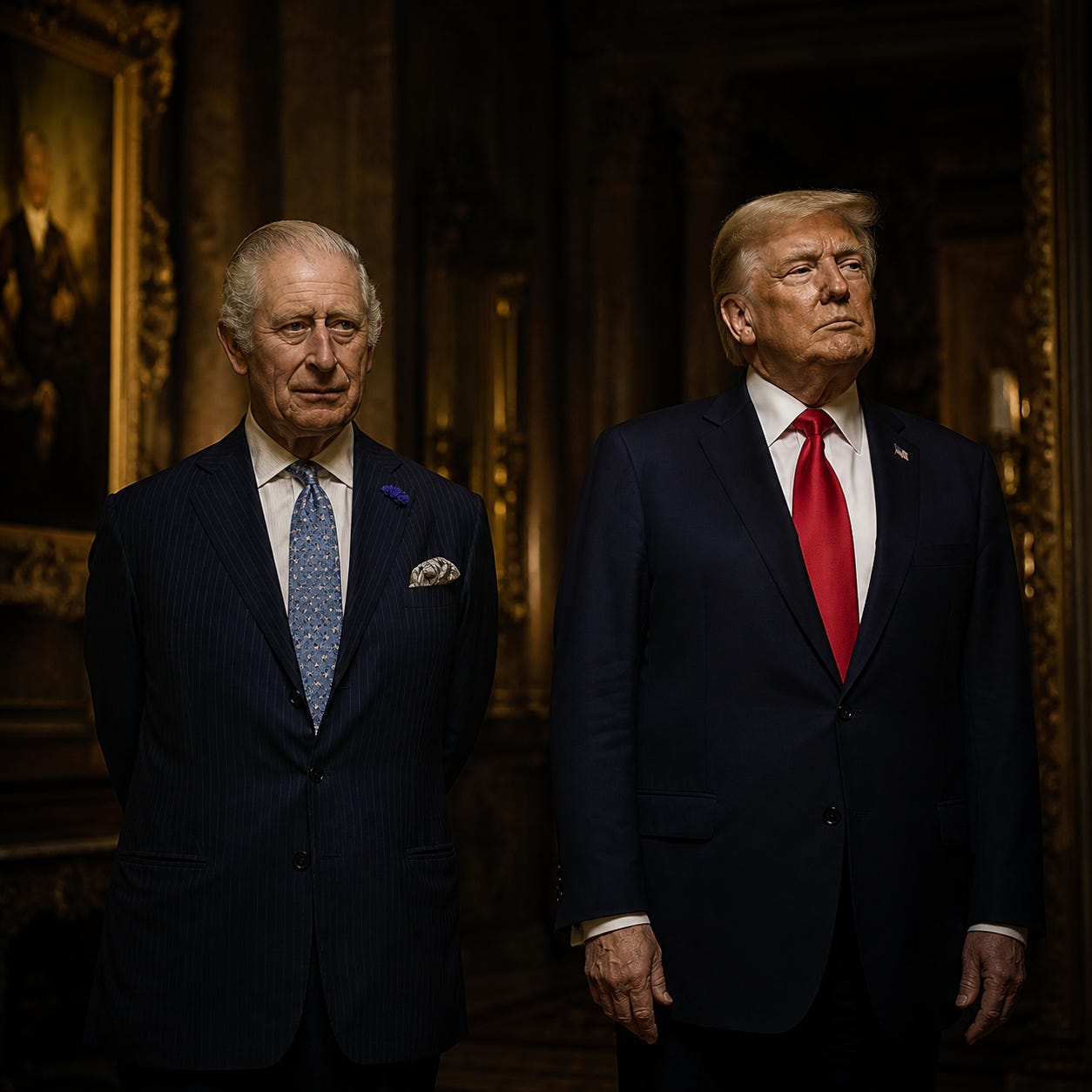
This week, King Charles III and Queen Camilla completed a four-day state visit to the United States — the first by a British monarch in two years.¹ He addressed Congress. He had tea at the White House. He shook the hand of the man whose administration is currently arguing in federal court that the law doesn’t fully apply to him.
King Charles III — born into his throne, never subjected himself to a single election, never asked for your vote, never needed it — is currently more constitutionally constrained than the President of the United States.
He cannot pass a law. He cannot override Parliament. He cannot fire a judge because a ruling inconvenienced him. He cannot stand before the nation and declare that his office grants him the right to do whatever he wants.
The man you were raised to see as the symbol of everything America was built to escape? He submits to the law.
And the man elected to protect you from exactly that kind of power? He’s arguing in federal court that the law doesn’t fully apply to him.
I want you to sit with that inversion before you decide what it means. Because the temptation — on both sides of the current divide — is to reach immediately for a comfortable explanation. The Trump supporter will call this liberal hysteria. The resister will call it proof that the system is broken and must be restored.
Both are wrong. And I’ll tell you why
2 — THE TITLE TRAP
We have been trained, from childhood, to respond to words as if they were facts.
King. Something in you tightens. You think: tyranny. Inherited power. The divine right to rule without consent. The thing America was born to escape.
President. Something relaxes. You think: chosen. Accountable. Temporary. The people’s servant, bound by oath and law.
But what if the title is just a word? What if the architecture of power has quietly outgrown the language we use to describe it?
Because here is what Donald Trump and his legal team have argued — not implied, not suggested, not floated as a talking point — argued in federal court: that Article II of the Constitution grants the President nearly unlimited authority over the executive branch. That a sitting president cannot be meaningfully investigated, cannot be effectively checked, cannot be held to the same laws that govern every other citizen of the republic he was elected to serve.
In one stretch of legal filings alone, the administration argued that federal judges were improperly interfering with presidential authority in 97% of cases studied.² Legal scholars have described the administration’s posture plainly: it is “attacking the ability of federal judges to question or review executive actions.”³
They have a name for this doctrine. They call it the Unitary Executive Theory.
You can call it what it actually is.
The Divine Right of Kings.
Same idea. New wardrobe. The monarchy didn’t follow us across the Atlantic in the form of a crown and a throne. It followed us in the form of a legal argument — dressed in constitutional language, argued by lawyers in expensive suits, normalized through repetition until it began to sound like scholarship rather than the ancient claim it actually is: that the right man, in the right office, is above the law.
The irony is not subtle. The man elected to protect you from the tyranny of kings is making the king’s argument. And the king — the actual, literal, hereditary king — is submitting to Parliament.
We were taught to fear the wrong costume
3 — THE ARCHITECTURE
Here is where it gets uncomfortable.
Not for the Trump supporter — they stopped reading two sections ago. This is where it gets uncomfortable for the resister. For the marcher. For the person who showed up with the banner that reads No Kings and meant every word of it.
Leah Greenberg, co-founder of Indivisible, spoke for millions when she said: “There is nothing more American than saying, ‘We don’t have kings’ and exercising our right to peacefully protest.”⁴ Over 2,600 demonstrations formed across all 50 states. The movement has returned in wave after wave — a third edition of No Kings rallies emerged in 2026 alone.
I mean every word of it too. And I need you to stay with me.
Tad Stoermer, an American critical historian currently living in exile in Denmark, cuts through the comfortable resistance narrative with surgical precision: “There are people right now, writing in places like the New York Times, telling you Donald Trump is George III. The parallel sounds clever. It sounds learned. It gives readers a tyrant, a sacred text, and a line from Jefferson to quote back at the monster. It also does real harm to their ability to understand what is happening in front of them.”⁷
Stoermer is right — and he's pointing at something deeper than a bad historical analogy. The George III comparison gives the resistance a clean villain and a clean story. A tyrant, a founding, a restoration. But the American founding was not what that story requires it to be.
The Founders were not naive men.
They were wealthy, propertied men who had just finished a revolution and were now tasked with building something that would protect their interests while appearing to serve everyone’s. They were lawyers and landowners and slaveholders and visionaries — often the same man wearing all four of those titles at once. They understood power because they had it, had fought for it, and had absolutely no intention of surrendering it to the mob they had just invited to help them win a war.
They feared two things equally — a king and a mob.
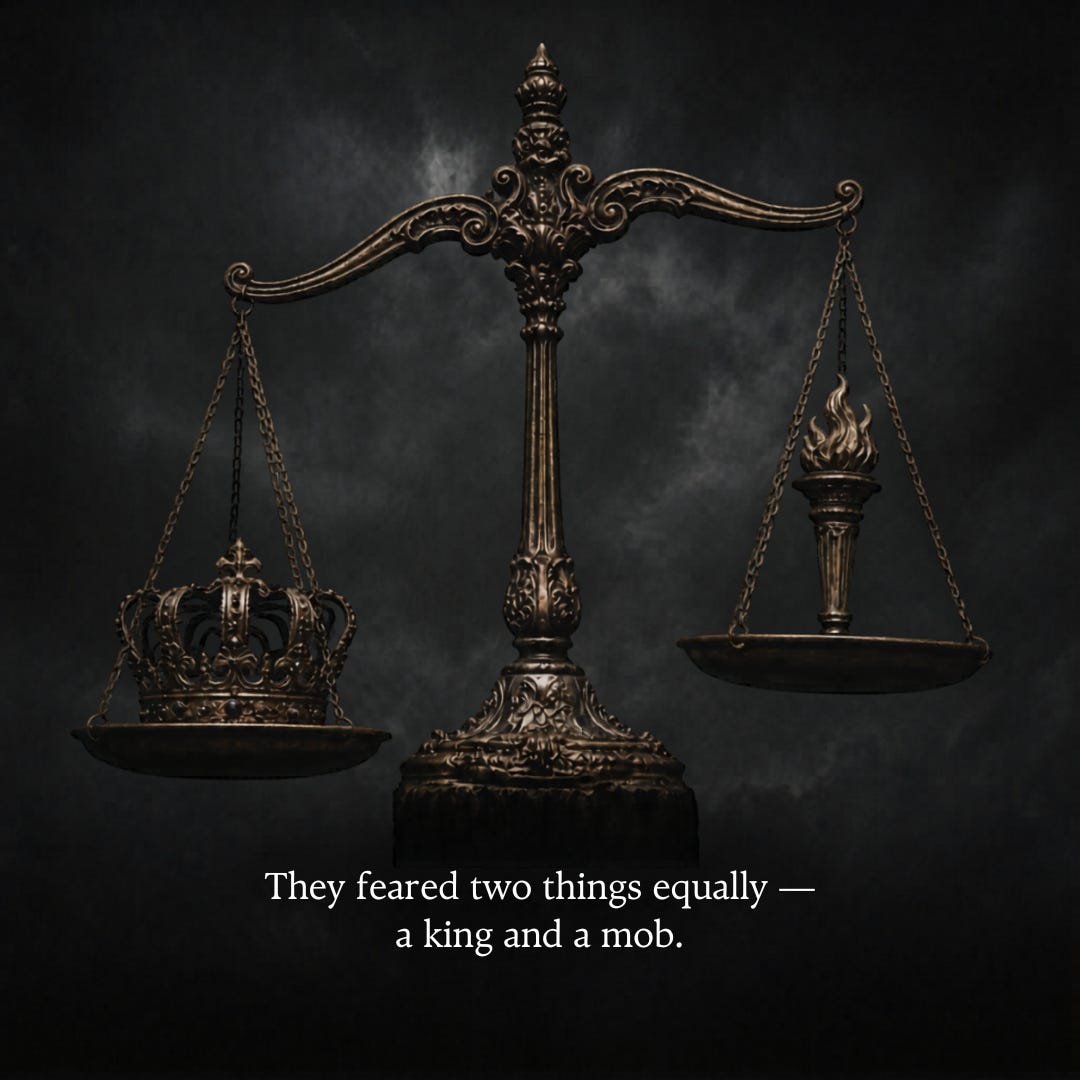
So they built something that could check both.
Not a democracy. Not in the way the word is used today, not in the way it appears on protest signs and bumper stickers and Fourth of July speeches. What they built was a managed republic — a system carefully engineered to distribute just enough power downward to maintain legitimacy while concentrating the real levers of governance in the hands of a specific class of people.
Elite by architecture. Democratic by branding.
Madison was transparent about the design in Federalist No. 10. A large republic, he argued, was preferable to a pure democracy precisely because it filtered the passions of the majority through elected representatives — men of property and standing who could be trusted to deliberate rather than react. The republic was built to slow popular will, not serve it.⁵
Hamilton went further. In Federalist No. 70 he argued that “energy in the executive is a leading character in the definition of good government.”⁶ A strong, decisive, singular executive — this was not a fear of the Founders. It was an aspiration. The Unitary Executive Theory did not appear from nowhere. It grew from a seed Hamilton planted deliberately.
Tad Stoermer, writing on the structural logic of the American founding, puts it plainly: the genius of the system was not its democratic spirit — it was its ability to make elite management feel like popular sovereignty.⁷ The guardrails people are mourning right now — the independent judiciary, the separation of powers, the sacred balance of the three branches — were never designed to protect everyone equally. They were designed to protect the system. And the system was designed to protect property, order, and the interests of those who already had both.
This is not cynicism. This is architecture.
And what we are watching right now — a president who claims the law bends to his will, who fires anyone who resists, who treats the institutions of government as personal instruments — is not a betrayal of that architecture.
It is one of its logical conclusions.
The Founders feared a demagogue. They built mechanisms to slow one down. But they also built a system that, under the right conditions, with the right pressure applied in the right places, could produce exactly what we are watching. Madison wrote about it. Hamilton worried about it. They hoped the mechanisms would hold.
The mechanisms are bending.
And the people marching in the streets to restore them are marching, in part, to restore a system that was always more myth than miracle — and calling it a golden age.
4 — THE SILENCING
Michel-Rolph Trouillot wrote that power doesn’t just shape the present — it shapes the past. It decides which stories get told, which voices get archived, which silences become so complete that they stop feeling like silences at all and start feeling like simply the way things were.
He called it the silencing of the past.⁸
We have been living inside one.
The story goes like this: America was founded on an idea. The idea was imperfect but salvageable. The founders were flawed but visionary. The system they built was designed to correct itself over time, to bend toward justice, to absorb the shocks of history and emerge more perfect than before. And so whenever America fails — whenever the system produces something monstrous — the failure is framed as a deviation. An aberration. Something foreign to the founding spirit that must be resisted and reversed.
It is a beautiful story.
It is also a story that requires you to forget a great deal.
Ask the people who were written into the Constitution as three-fifths of a human being how self-correcting the system felt. Ask the people whose land was taken, whose nations were dissolved, whose existence was treated as an obstacle to manifest destiny. Ask every woman who lived and died in this country before 1920 whether the sacred democratic spirit extended to them. Ask the people who were lynched in the decades after emancipation while the system corrected itself slowly, carefully, at a pace that the powerful found comfortable.
The system did not fail these people.
The system worked exactly as designed for a very long time — and the expansions of rights and dignity that came later came not because the system self-corrected, but because people fought, marched, bled, and died to force it to move. The system resisted. The people insisted. That is a different story than the one we tell ourselves.
Trouillot’s insight is devastating in its simplicity: the version of history that feels natural, that feels like common sense, that feels like simply the way things were — that version has been curated. Constructed. The silences are not accidental. They are the product of power deciding what gets remembered and what gets forgotten.
The golden age that the No Kings movement is appealing to — that age of democratic norms and institutional integrity and sacred checks and balances — existed. For some people. Under certain conditions. With significant and violent exceptions that the story prefers not to dwell on.
And the resistance that holds that golden age as its north star is, in part, fighting to restore a story rather than build a reality.
That is not a reason to stop fighting.
It is a reason to fight differently. To fight honestly. To fight with your eyes open to what was, rather than closed around what you wish had been.
5 — THE ONLY HONEST HOPE
So here is the full picture. Both sides of it.
Donald Trump behaves like an unchecked monarch. That is true. That is not hyperbole. That is what the historical record looks like when you hold it up to the light without flinching. The claim that presidential power is effectively unlimited, the systematic dismantling of institutional independence, the treatment of law as obstacle rather than boundary — these are not the behaviors of a democratic leader. They are the behaviors of a man who has decided that his will is the law. And a system that cannot stop him is failing at the most basic level of its stated purpose.
The resistance is right to resist. I want to say that clearly and without qualification.
And.
The system that was supposed to prevent this was always more fragile than the story admitted. The guardrails were always negotiable. The norms were always dependent on the good faith of people in power choosing to honor them. And the golden age being mourned — the era of democratic decency and institutional integrity that the No Kings movement is fighting to restore — was golden for some and not others, and even for those it served it was never as secure as the myth insisted.
This is what Stoermer is reaching toward when he warns that the George III comparison does real harm — not because Trump isn’t dangerous, but because the story it tells about American democracy is false. And false stories produce false solutions.
The American founding did not produce a democracy. It produced a managed republic that was elite by architecture and democratic by branding — and one of its logical conclusions, under sufficient pressure from a sufficiently ruthless actor, was always going to look something like this. Hamilton’s energetic executive, unmoored from the norms that were supposed to contain him, is not a betrayal of the founding vision. In some ways, he is its fullest expression.
The No Kings banner is right about the present.
It is wrong about the past.
And resistance built on a myth will always have a ceiling — because the moment you win, you will be tempted to restore something that was never what you thought it was. You will call it a victory. You will go home. And the architecture will remain exactly as it was, waiting for the next man who decides that his will is the law.
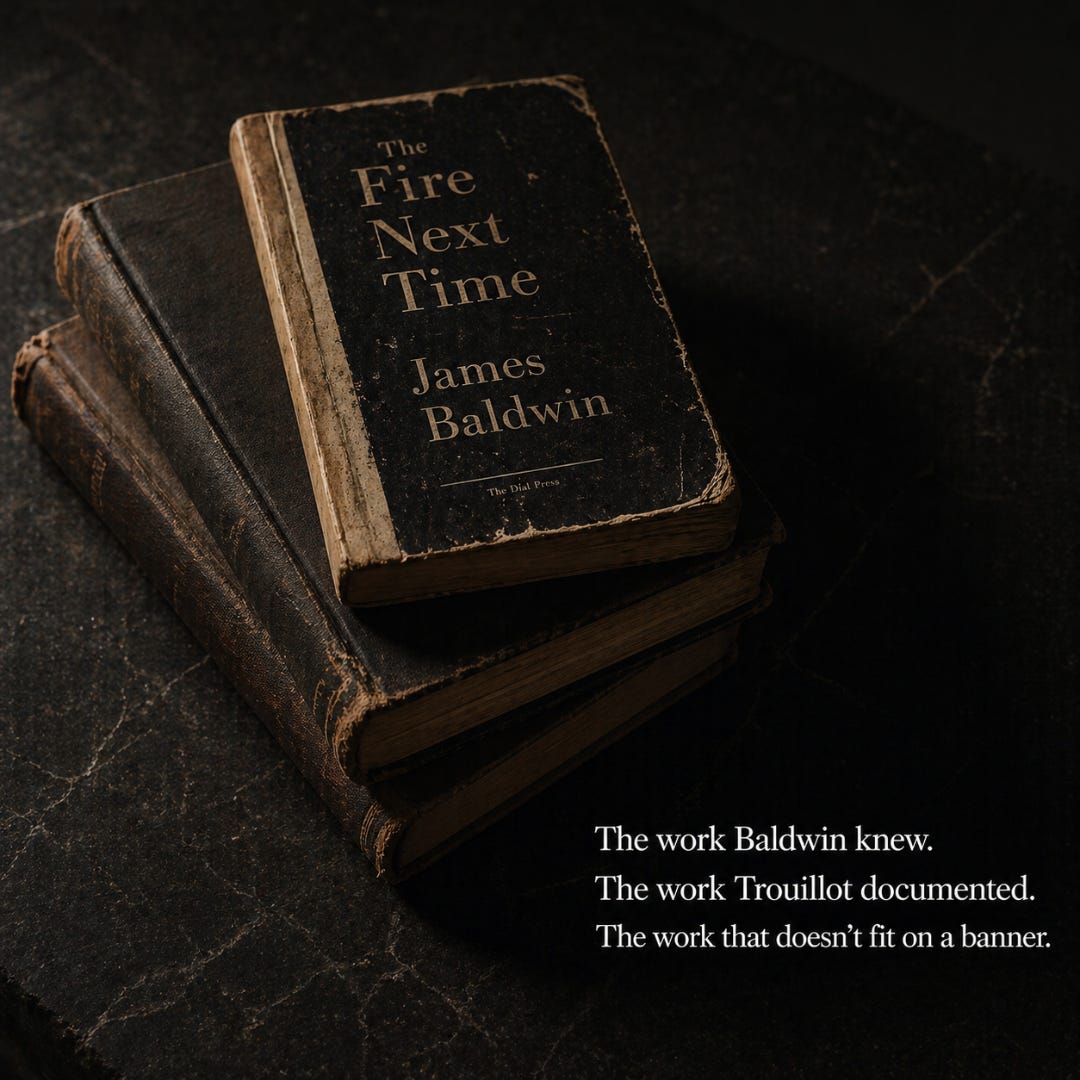
The harder work — the work Baldwin knew, the work Trouillot documented, the work that doesn’t fit on a banner and won’t trend on a Friday afternoon — is to stop asking how we get back to the America that was, and start asking how we build the America that never existed.
Not the America of the founding myth. Not the America of selective memory and silenced history. But an America that actually does what it has always claimed to do — that extends its stated values to every body within its borders, that builds institutions accountable to everyone rather than protective of the few, that tells the truth about what it has been so that it can imagine something more honest about what it might become.
That project is harder than resistance. It is longer than a protest cycle. It does not fit on a banner.
It is also the only project worth doing.
That’s not pessimism.
That is the only honest form of hope left.

Avi Penhollow is a writer, educator, and author publishing under Penhollow | Studiolabs. This essay is part of the No Kings series.
avipenhollow.com
FOOTNOTES
¹ Reuters, “Britain’s King Charles and Queen Camilla embarked on a historic four-day state visit to the United States,” April 28, 2026.
² Reuters, “How Donald Trump is pushing the Supreme Court to weaken federal judges,” March 7, 2026.
³ Ibid.
⁴ Reuters, “No Kings rallies expected to draw millions across the U.S.,” October 18, 2025.
⁵ James Madison, Federalist No. 10 (1787).
⁶ Alexander Hamilton, Federalist No. 70 (1788).
⁷ Tad Stoermer, "Donald Trump Is Not George III," Substack, May 6, 2026.
⁸ Michel-Rolph Trouillot, Silencing the Past: Power and the Production of History (1995).