


If you flipped on cable news or scrolled through social media recently, you were likely told that a political earthquake just flattened the state of Texas. With Ken Paxton defeating four-term incumbent John Cornyn in the Republican Senate primary runoff, the immediate narrative plastered across our screens was loud, uniform, and absolute: Trump’s power is unbreakable, his authority is total, and the mandate is sweeping.
It is a spectacular show of confidence.
But if you turn down the volume and actually look at how the machinery operates, you start to notice something strange. This wasn’t a sudden, organic wave of popular will; it was a carefully engineered illusion. To understand how it works, you have to look at the math they don’t want you to do.

In a primary runoff held right after a holiday weekend, only a tiny fraction of the most passionate, hard-core party activists actually show up to vote—frequently representing less than 5% of the total population of the state. Yet, within minutes of the race being called, a massive apparatus of party-adjacent networks and billionaire-funded political action committees (PACs) took that tiny drop of rain and sold it to you as a historic tidal wave.
This is what we call The Infallibility Loop, and it is the most powerful weapon in modern American politics. The strategy is simple: a politician claims absolute credit for a low-turnout victory, a media network immediately amplifies that claim to protect its own TV ratings, and mega-donors pour millions of dollars into the machine because they want to bet on the perceived “winner.” They aren’t actually reporting a sweeping mandate from the American people; they are posturing. They are manufacturing the feeling of an unstoppable victory so that you keep watching, keep agreeing, and keep funding a machine that turns your attention into their power.
Behind the Curtain: How the Machinery Operates
To understand how a tiny fraction of voters can be packaged into an “unshakable mandate,” you have to look at the three gears that drive this machine. When they turn together, they create a political perpetual motion market.
Gear 1: The Manufactured Endorsement
The play starts long before Election Day. A candidate lobbies for a high-profile endorsement—not to win over independent voters, but to establish a psychological baseline. When Donald Trump endorsed Ken Paxton just days before the runoff, it wasn’t a casual nod. It was the insertion of an insurance policy.
If Paxton lost, the narrative would have been simple: “The establishment rigged it, or the candidate wasn’t MAGA enough.” But because Paxton won, the pre-written script was activated instantly: “This is total proof of absolute authority.” It is a strategy where the architect literally cannot lose, because the baseline reality is whatever they declare it to be.
Gear 2: The Network Echo Chamber
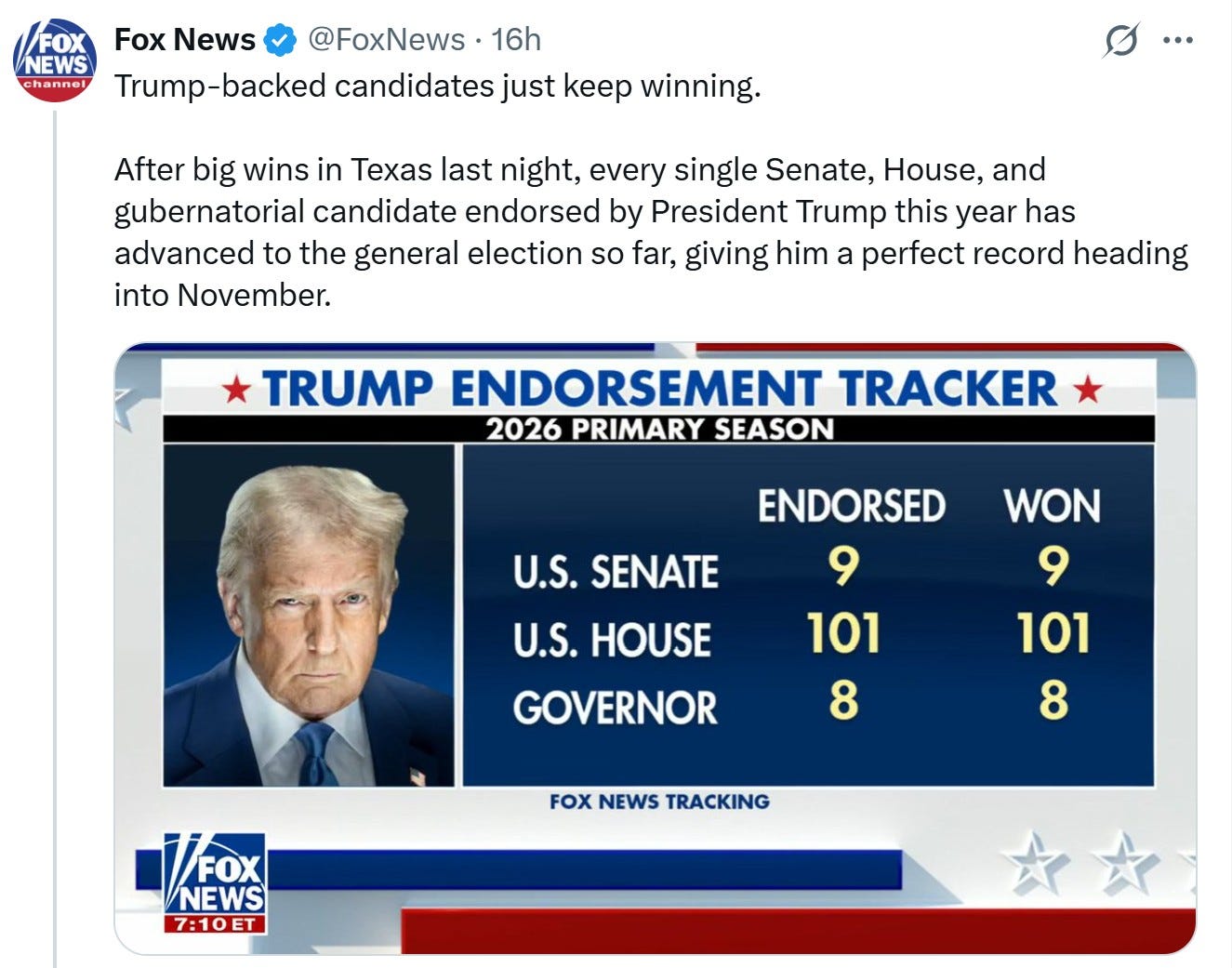
News networks are businesses, and their most valuable commodity is viewer validation. They know that audiences don’t tune into political commentary to be challenged; they tune in to feel like they are on the winning team.
When the Texas results came in, party-adjacent networks didn’t report the nuance. They didn’t mention that John Cornyn actually led the initial primary back in March, or that runoffs held immediately after a holiday weekend naturally filter out moderate, everyday voters. Doing so would break the spell. Instead, they mirrored the politician’s victory script word-for-word, feeding their viewers a concentrated dose of political triumph.
Gear 3: The Billionaire PAC Incentive
This is where the real power hides. Narratives are expensive to maintain. They require millions of dollars in continuous ad buys, sophisticated digital targeting, and constant media presence.
When a network spends 48 hours declaring a candidate’s “absolute dominance,” it signals something specific to mega-donors and corporate Political Action Committees: This lane is the safest place to buy influence. The illusion of momentum creates a magnet for capital. Even though Cornyn’s establishment backers outspent Paxton significantly in the overall cycle, the perception of Paxton’s inevitability—fueled by the endorsement and the media echo—secured the hard-core activist turnout needed to seal a runoff. The money follows the noise, and the noise follows the money.
The True Cost of the Illusion
When we allow ourselves to be swept up in this posturing, we lose sight of what an election actually is. It is supposed to be a civic calculation of how a community wants to be governed. Instead, it is treated like a pro-sports rivalry where the only thing that matters is the color of the jersey holding the trophy at the end of the night.
This system relies on a very specific kind of sleight of hand. It tells you that the primary victory is a sweeping mandate, while intentionally hiding the complications that follow. Look at how the spin measures up against reality:
What the Screen Tells You (The Spin)
What the Data Actually Shows (The Reality)
The endorsement represents a massive, sweeping mandate from the entire population.
Primary runoffs are notoriously low-turnout events dominated by the most partisan sliver of the electorate.
The narrative is powered entirely by grass-roots, organic momentum.
The Texas primary runoff became the most expensive Senate primary in U.S. history, fueled by massive financial backing.
The outcome means the general election is already over and decided.
Independent voters and moderates frequently react differently to highly polarized primary winners in a general election. The moment this specific runoff was called, nonpartisan election forecasters shifted the Texas Senate race rating from “Likely Republican” to “Lean Republican.”
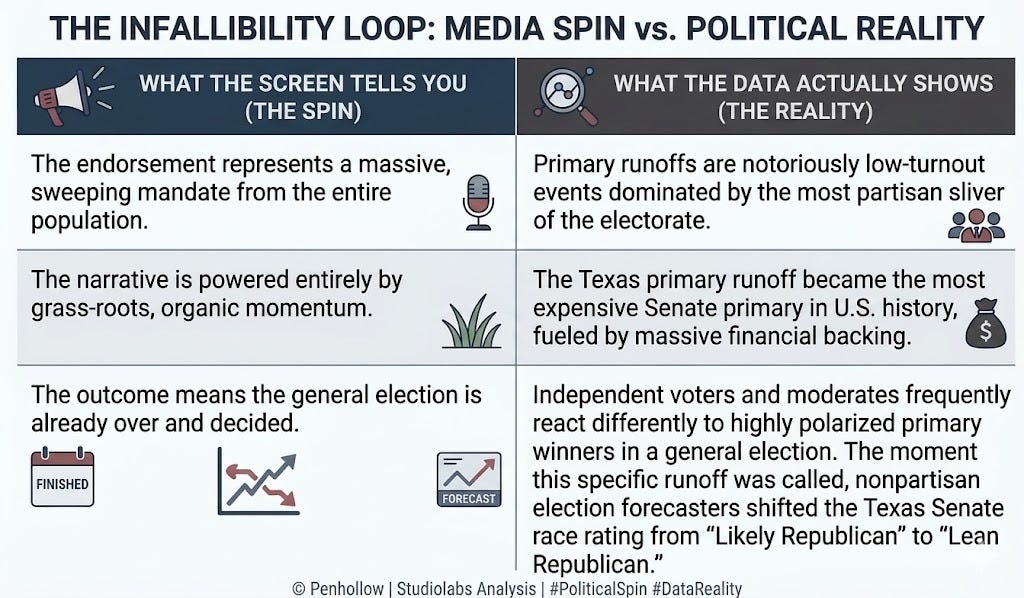
But you won’t hear that on the evening broadcast. To admit that a primary strategy might complicate a general election would require talking about math, voters, and messy realities—and messy realities don’t sell commercial slots.
Spotting the Loop in Real Time
The next time you see a headline declaring a “sweeping victory” or an “absolute mandate” after a local or primary election, don’t look at the graphics on the screen. Ask yourself three simple questions:
How many people actually voted? Was this a massive turnout of the entire community, or a tiny sliver of highly partisan insiders?
Who benefits from the noise? Is the network reporting a fact, or are they selling an emotional high to keep you glued to the screen for the next commercial break?
Where is the money moving? Is this a grassroots movement, or is it a corporate-funded pipeline designed to make a small group of donors look like a populist army?
The media narrative wants you to believe you are watching history happen. The reality is much simpler: you are watching a sales pitch. And the moment you realize what they are selling, the trick stops working.
They aren’t reporting on a victory; they are selling you the feeling of winning so you keep funding the machine.
Breaking the Loop: How We Take Back the Narrative
Exposing the machinery of the Infallibility Loop isn’t about breeding cynicism; it’s about demanding better. The people who spend millions of dollars to manufacture these media narratives do it because they are terrified of what happens when everyday citizens actually look past the screen.
The loop only functions when we stay passive—when we consume the outrage, accept the pre-packaged victories, and view our neighbors through the lens of a cable news graphic. Breaking it doesn’t require a political revolution; it requires a personal shift in how we engage with our communities.
Show Up for the Quiet Elections: The easiest way to break a machine that relies on 5% voter turnout is to make it 15% or 20%. When moderate, hardworking, everyday people choose to skip primary runoffs because they feel turned off by the noise, they hand the keys of the republic directly to the loudest voices in the room. The narrative loses its power the moment the quiet majority decides to show up.
Diversify Your Media Diet: If you only listen to the music playing in one room, you’ll eventually forget that other songs exist. Step outside the echo chamber. Read independent local journalism. Look at primary data yourself instead of letting a talking head summarize it for you. Seek out perspectives that challenge your assumptions not to change your mind, but to sharpen your critical thinking.
Reconnect Locally: The media machine wins when it convinces us that politics is a distant, high-stakes war between absolute good and absolute evil. But real life happens locally. Go to your city council meetings. Talk to your neighbors across the driveway about local schools or potholes—without mentioning the names you see on cable news. You will quickly find that the rigid, polarized categories invented by TV executives disintegrate when real human beings start talking to each other.
The Ultimate Choice
We are entering a season where the noise is only going to get louder. Every single speech, endorsement, and primary outcome will be processed through the exact same machine, designed to make you feel either completely invincible or utterly hopeless.
But remember: the screen only has the power you give it. The next time a headline screams about a “historic mandate,” take a deep breath, look at the actual numbers, and remember the trick.
They want you to believe you are just an audience member in their theater. But the reality is that the theater belongs to you. It’s time to stop buying the script, turn off the projector, and start rewriting the story ourselves.
Avi Penhollow is a writer, educator, and author publishing under Penhollow | Studiolabs.